November 24, 2014

2) John Adams - Father of the Navy

Following George Washington’s biography it is striking how different the second president of the United States was from the first. Washington was a farmer from Virginia, Adams a lawyer from outside Boston. Washington was a remarkably profligate consumer while Adams was prudent in the management of his personal finances. Washington was reserved, Adams was outspoken. Washington left the United States only very briefly as a young man while Adams spent much of his political career representing his country in Europe. Washington spent almost the entirety of his public life revered, while Adams often felt unappreciated by his contemporaries.

Abigail and John, often pictured in their later years, are
depicted here aged 22 and 31, respectively.
The beginning of Adams’ career is surprising to the uninitiated. While British resentment was simmering in Massachusetts, John Adams defended the Redcoat perpetrators in court much to the chagrin of his cousin, Samuel Adams. Ironically, Adam’s successful defense of the British soldiers made him an attractive choice to counteract the perception of Massachusetts’s delegation as a bunch of radicals. Once in Philadelphia, it was Adams that arguably led the divided Congress toward acceptance of independence.

After the Congress ratified the Declaration of Independence, on which Adams worked closely with Thomas Jefferson and Benjamin Franklin, Adam’s public duties took him to Europe where he served as an American diplomat in France, the Netherlands, and England. While in France he clashed with Benjamin Franklin whom Adams felt wasn’t a strong enough advocate for the American cause.

Common (American) knowledge says that John and Abigail’s marriage was extremely close and loving. While their numerous correspondences do show that they loved each other deeply and that Abigail made many thoughtful and insightful contributions to John’s political thinking, John Ferling paints a picture of John Adams as a largely absent father and husband. John’s many years spent in Philadelphia and Europe caused him to miss the childhood of his children and signs of the strain this put on his marriage are evident in some of the letters written by Abigail and by the amount of time that passed between letters Adams was alone in France (Abigail later joined him).

The election of George Washington as the first president of the United States was never in doubt, yet Adam’s felt the office of Vice Presidency was beneath him. He served nonetheless, and probably never truly considered rejecting the post. After Washington’s two terms, Adams was elected and served one term in what is often considered a flawed presidency. Despite some signs of Adams’s lack of political acumen, such as his retention of Washington’s cabinet which was more loyal to Alexander Hamilton than himself, the action that likely cost Adams a second term was his most important action as president. During the Quasi War with France, Adams resisted political pressure to declare war on France and was able to prevent American involvement in a largely European conflict that surely would have been grueling for the young republic. Adams was bitter about the effect this had on his popularity and his ability to secure reelection in 1800, but to his credit he did not second guess his decision to avoid war with France which is evident in his request for his gravestone to read 'Here lies John Adams, who took upon himself the responsibility of peace with France in the year 1800.'

I think that John Adams’ defeat in the 1800 election is sufficiently explained in my prior post ‘A Saturday Interview.’ Following that defeat Adams' largely withdrew from public life despite living for another quarter century. The letters that resulted from the rekindling of his friendship with Thomas Jefferson are the most enduring part of John’s legacy to come from this period of his life.

In addition to an outline of Adams’s life, Ferling’s biography presented some interesting information on life in America in the late 18th century. For example, at the time that Adams went to Harvard only ½ of 1% of American men and no women attended college. Ferling also explained the solitary and dangerous method by which people were inoculated against small pox wherein the patient was exposed to a small amount of small pox via an incision. The illness was then allowed to run its course as the patient was quarantined sometimes with others who were inoculated. 

Ferling also helped the reader to better understand Adams, teaching us about Adams’s belief that an under-and-over class and subsequent class warfare was unavoidable in a society and that a governing legislature should be designed in such a way as to represent both classes and alleviate tensions. Readers also learned about the guilt Adams felt at having never served in the military, going so far as to appear in military uniform during public appearances during the Quasi War with France.

While historians seem to agree that Adams is not one of America’s great presidents, his greatness is evident in his respect for the rule of law, his work at the Continental Congress, and his fierce independence and thus avoidance of full-scale military conflict with France during the Quasi War. After reading Ferling’s biography, I would argue that Adams was instrumental in Congress’s acceptance of separation from England and the structure of the subsequent American government. So if it is decided that Adams was not a great president, I’d say that Adams was still a crucially important founder and a great American.

November 1, 2014

ASIDE: A Saturday Interview

A benefit to living in the New York City area is that; like Philadelphia, Boston, and Virginia; there are a lot of field trips to go on when learning about the founders. Last Saturday, my wife and I went on a three mile walk from our apartment to one of those sites.

Atop the Palisades in Weehawken, New Jersey, not far from where General Washington watched his troops get routed by the British at Fort Washington, is the location where Alexander Hamilton and Aaron Burr’s rivalry came to a head.

While my presidential biographies will examine the prelude to Burr and Hamilton’s disastrous encounter several times, the story, as I currently understand it, goes as such…

The election of 1800 pitted Republicans Thomas Jefferson and Aaron Burr against Federalists John Adams and Charles Pinckney. This was prior to the 12th Amendment so each member of the Electoral College cast two votes for president with the top two candidates becoming President and Vice President. In the event of a tie, the House of Representatives decided the election.

Alexander Hamilton despised Jefferson. They were at opposite ends of the political spectrum. However, Hamilton also hated fellow Federalist John Adams for his opposition to the New Army in which Hamilton would serve in leadership. Hamilton, a man with many enemies, also had a history with Burr who had won a US Senate seat from Hamilton’s father-in-law.

In the election of 1800, Jefferson and Burr tied. Instead of acknowledging that Jefferson was president, Burr engaged with Federalists in the House attempting to outline a deal by which they could swing the election in his favor. It took 36 ballots, but eventually Jefferson prevailed. Not only had Burr lose the presidency, but he lost the trust of his president.

Due to his intrigue with the Federalists, Jefferson informed Burr that he would not be his running-mate in 1804. Burr sought the New York governorship as a consolation prize, a notion that spooked Hamilton who believed Burr could use the governorship to galvanize or fracture New York Federalists, either way marginalizing Hamilton. While not directly involving himself, Hamilton orchestrated an all-out smear campaign ensuring Burr’s defeat. The following June, Burr came across a newspaper article claiming that Hamilton had called Burr a “dangerous” and “untrustworthy” man. Now that Burr had something substantial to implicate Hamilton in the mudslinging, he wrote to Hamilton demanding to know the truth. Instead of denying the charge, and likely ending the ordeal, Hamilton quibbled about Burr’s choice of words prompting a second letter from Burr specifying that he wanted to know whether Hamilton had called his honor into question. To this Hamilton replied, “I have no other answer to give than that which has already been given.” A few additional letters changed hands, but at this point their fates were sealed.

As dueling was punishable by death in New York, it was spoken about cryptically. The “interview”, therefore, was scheduled for July 11, 1804. It was to be held in New Jersey where duelers were treated less harshly. Burr arrived first with his friend William Van Ness, Hamilton came with Nathanial Pendleton as his “second”. A doctor and the oarsmen waited out of sight, to limit the number of witnesses, as the duel commenced. No one knows exactly what followed. Van Ness and Pendleton initially issued a joint statement, however they never fully agreed on the events that took place. Both Hamilton and Burr had devotees who sought to shape the sequence of events that day in order to best defend their man’s reputation.

What is known is that, while neither man likely expected to die, Hamilton suffered a mortal “gut shot”. He would live for another 31 hours, but never fully regain consciousness. Burr was charged with murder, charges that were eventually dropped. While he was able to serve out his term as Vice President, his political career was effectively over. Following the vice presidency he traveled out West, then to Europe, then back to New York where he would die 32 years after the duel.

A great succinct account of the duel and the political atmosphere surrounding it can be found in Joseph Ellis’s book Founding Brothers. Below are some pictures I took from the location around the dueling site. To my disappointment, the ledge on which the duel occurred no longer exists.

Overlooking the Hudson River and Manhattan.

A promenade overlooks New York City.

A bust of Hamilton, along with a plaque commemorating
the site, sits at the cliff's edge.

The current Weehawken waterfront consists of expensive,
luxury apartment buildings. 

A view capturing both the Empire State Building to
the left and the new One World Trade to the right.

October 25, 2014

ASIDE: A Few Interesting Facts to Wrap-up Washington

  • The American mule, a cross between a male donkey and a female horse, can trace its roots back to Mount Vernon where Washington pioneered the breeding of them in America.
  • Washington was mostly deaf by the end of his presidency. William Maclay wrote of a dinner with the president that, “he seemed more in good humor than ever I saw him, tho he was so deaf that I believe he heard little of the conversation.”
  •  Washington instituted our Thanksgiving holiday to thank God for the “tranquility, union, and plenty” of the country.
  • Middle Eastern terrorism was not just a twenty-first century issue. North African pirates disrupted Mediterranean trade and would demand bribes under the threat of forced conversion to Islam. Washington once paid a bribe to secure the release of 11 American merchant ships and 100 prisoners, an act that led to the creation of the first US warships inaugurating the US Navy.
  • While the Whiskey Rebellion wasn’t a highlight of Washington’s presidency, it did allow for the only time in US history where the sitting president supervised troops in a combat situation. Washington was 62 years old at the time.
  • To highlight how unusual Washington’s behavior in relinquishing his leadership roles seemed to European onlookers, King George III said that by giving up his military and political power Washington proved himself to be “the greatest character of the age.”
  • A fitting quote to wrap up Washington comes in a letter he wrote at the end of his second term to John Trumbull. Many were imploring Washington to stand for a third term, but he had made up his mind to retire: “I trust that the good sense of our countrymen will guard the public weal against this and every other innovation, and that, although we may be a little wrong now and then, we shall return to the right path with more avidity.”  

1) Washington: The Enigma

General Washington at Trenton, as
depicted by Charles Wilson Peale
While Washington is one of the best known presidents, very little about his personality is common knowledge to modern Americans. Even the enduring picture we have of Washington, on the dollar bill, is a painting of a man at the end of his life and haggard by political infighting that marred his second presidential term.

What follows are some of the anecdotes about Washington’s character, from Chernow’s book, that stuck with me.

It is evident that Washington was obsessed by status. He disliked the lack of respect shown to colonists by the British. Young Washington gained acclaim in the French and Indian War, however it angered him that he was never awarded the royal commission that he both desired and lobbied for. Additionally, letters to the  London firm with which Washington traded to obtain the wares of  British aristocracy show a man who was deferential despite  persistent suspicions that he was being ripped off. It is  disconcerting to know that the man who commanded the  Continental Army and drove the British from the United States  yearned for their approval. It would be an interesting exercise in  the counterfactual to consider how American history may have been altered had Washington received that royal commission.

As a general, Washington enforced discipline in a way that is shocking to the modern reader. He whipped retreating soldiers from his horse during battle, ordered soldiers to publicly execute mutinous comrades, and often exposed himself to danger on the front lines of battle. This isn’t meant to paint the picture of a cruel or cavalier general. It is important to realize that the “army” he commanded was vastly outnumbered, underfed, underclothed, and un-or-underpaid. Washington shouldered two unimaginable burdens, holding the army together and thwarting the British. He battled rampant illness and short assignments that had him training a seemingly new army each spring. Washington loved the men who stuck with him. He fought for better provisions and payment, he did not hide from danger behind his men, and he personally signed thousands of the discharge letters at the war’s end.

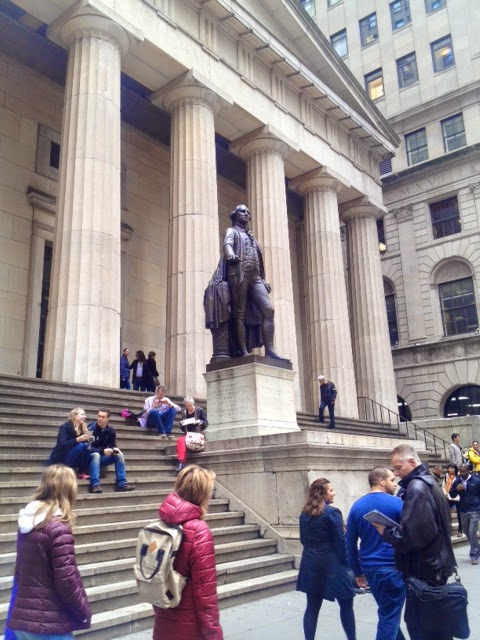
Federal Hall in New York City: The
site of Washington's first inauguration
Washington, the president, was very conscious of the precedents that he would be setting. He is often portrayed as a reluctant president, and in some ways he probably was. It was a shocking display of republican values that Washington could resign his generalship after the war. He feared that accepting the presidency would confirm to the world that he was just as power hungry as successful generals before him, not the Cincinnatus Americans saw him as. At the beginning of his generalship, presidency of the Constitutional Convention, and presidency of the United States, Washington made it clear that he had been compelled to do the job. Whether he wanted nothing more than to live out his days at Mount Vernon, he was a masterful politician, or something in between, there is no doubt that he was extremely sensitive about how history would view him. The thought that the country he had given much of his life to help form might require his stewardship to incubate its new government likely left him feeling that he had no choice but to serve. For a man who was unanimously elected president three times (Constitutional Convention and twice as President of the United States), the partisanship between Jeffersonians and the Hamiltonians (i.e. the republicans and the federalists) that took form during his second term was difficult on Washington and quickly wore him down both mentally and physically.
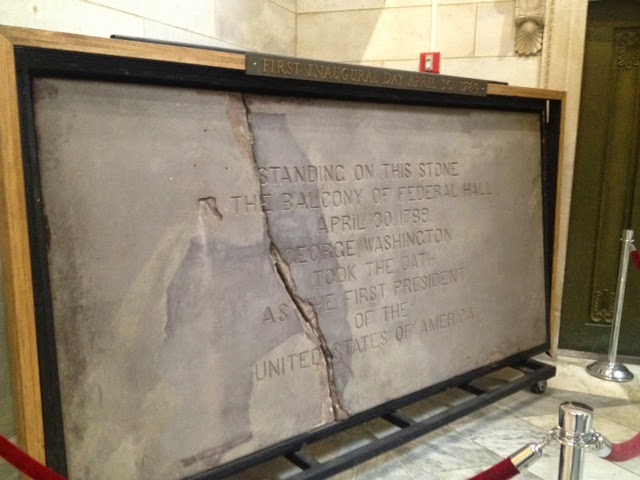
Inside Federal Hall are many Washington relics including
this stone slab on which Washington stood during his first
inauguration.

The issue of slavery is the most troubling aspect of Washington’s character. Washington clearly knew he was on the wrong side of history as a slave owner. He spoke of manumission with abolitionist peers such as Lafayette. Hamilton, maybe not worthy of the title abolitionist, also pushed Washington against slavery. However, Washington never made the stand against slavery that he could have. His signing of the Fugitive Slave Act, efforts to capture slaves that escaped from Mount Vernon, and ability to tailor his views on slavery to fit his audience paints a picture of a man who recognized the contradiction of slavery in the new republic but did not believe the young nation or his personal finances could afford to challenge the institution. In a final act of courage on the issue, or perhaps cowardice, Washington’s will called for the emancipation of his slaves upon Martha’s death. She ultimately freed them soon after Washington died.

October 12, 2014

ASIDE: Washington in New Jersey: The War

My odyssey through the presidents begins with Ron Chernow’s Washington: A Life.

Having grown up in Northern New Jersey, George Washington was somewhat of a presence. Legend has it that George had picnicked under a local oak tree, visited his soon to be trusted general Lord Stirling at Stirling’s local estate, and spent two winters in Morristown with his army (albeit less famously than their Valley Forge winter).
Mrs. Theodosia Ford’s Mansion in Morristown, Washington’s HQ during the winter of 1779/80


It turns out that Washington’s troops spent a great deal of the Revolution moving throughout New Jersey. It was from General Charles Lee’s ill-fated eponymous fort on the banks of the Hudson that Washington narrowly escaped death, a feat he repeated many times, and watched General William Howe’s Red Coats kill or capture nearly 3,000 American soldiers across the river at Fort Washington.

Washington’s Christmas crossing of the Delaware is likely his most famous act in New Jersey, but its significance in the war was unknown to me. Washington was coming off of a disastrous loss of New York City to the British highlighted by the loss at Fort Washington, troops were deserting in droves, and New Jersey residents were declaring their loyalty to the British much as those of New York City had done. It seemed unlikely that Washington’s army or the revolution itself was going to survive the winter of 1776/77 if Washington couldn't change the tide. Such was the context of Washington’s decision to gamble the future of the revolution on a Christmas-night raid of Johann Rall’s Hessian troops at Trenton. The importance of success at Trenton was underscored by Washington’s decision to keep the raid a secret from his troops, even as they marched toward the river. As an aside, it is shocking to read about the deplorable state of the American army, Chernow describes Washington’s men’s “bare feet tracing bloody streaks in the snow” as they marched toward the river. The crossing was a day-long affair. The march toward the river began mid-day on Christmas and the 2,400 men hadn't finished crossing until 3:00am. At that point, it was a nine mile march, through a nor’easter, to Trenton. The fighting began at 8:00am and contrary to legend, the Hessians were not hung-over from Christmas revelry, however they were likely caught off guard given the storm. The final tally counted nearly 1,000 Hessians killed or captured and less than 10 American deaths, mostly from succumbing to the weather. From Trenton, Washington’s army went on to defeat Cornwallis’s troops at Princeton giving him two improbable victories going into the winter encampment at Morristown and changing the tone of the Glorious Cause.

A depiction of the crossing by artist Peter Fiore
With half of Chernow’s book left to go, I look forward to learning more about Washington’s years after the war, especially as the first American president.

Introduction

When Lincoln was released in 2012, I loved the movie, but it made me aware of how little of my country’s history I knew. I knew Jefferson wrote the Declaration of Independence, Lincoln signed the Emancipation Proclamation, and Cleveland served the only non-consecutive terms. But what did James Monroe do? What was going on during Buchanan’s presidency as the country moved to the precipice of civil war? Who the heck is Chester Arthur?


After a couple years entertaining the idea of reading through these biographies, and inspiration from two other blogs documenting similar journeys, I've decided to start. With no idea when or if I’ll complete the project, this blog is intended to serve as my notes as I work my way through biographies of the presidents of the UnitedStates of America.