Showing posts with label George Washington. Show all posts

October 24, 2016

17) Andrew Johnson - Sir Veto

For no other president, to this point, has the consensus opinion changed so drastically. As recently as the 1960s Andrew Johnson was seen as the man who attempted to shepherd through Lincoln’s magnanimous policy toward reconstructing the South; a defender of the Constitution and its system of checks and balances against the vindictive Radical Republicans led by Thaddeus Stevens. Johnson is now more likely to be viewed as a humorless racist with no regard for the atrocities being committed in the Southern states.  As is often the case, the truth is probably somewhere in the middle.

Johnson grew up fatherless and poor, born in a shack in North Carolina. He had no formal schooling and taught himself to read. When he reached adulthood he moved to Tennessee and served as the town tailor. He continued to learn and joined debating societies where he impressed locals, who would ultimately elect him to various offices including mayor, the state legislature, four terms in the House of Representatives, governor of Tennessee, and ultimately to the United States Senate. He was known as a good speaker in Congress and he instituted Tennessee’s first public school system as governor.

After Lincoln’s election Johnson made himself into a national figure. Johnson was the lone Southern voice in Congress to speak out against secession and even returned to Tennessee to attempt to keep his state in the Union. This was a courageous and lonely act which put him and his family in physical danger. They were forced to flee to Kentucky when Tennessee joined the Confederacy. When the Union Army was able to take control of parts of Tennessee, Johnson was installed by Lincoln as wartime governor.

Andrew Johnson
When Lincoln ran for his second term, Johnson was nominated for Vice President in place of Hannibal Hamlin. Johnson was seen as an ideal personification of the bridging of the gap between North and South, Republican and Democrat. After winning his second term, Lincoln gave the famous speech in which he appealed to the country to heal “with malice toward none, with charity for all…” However, shortly before that celebrated address Johnson was sworn in in the Senate chamber where he was an embarrassing spectacle. Though not otherwise known as a drunk, he showed up in a bad way. He rambled for nearly fifteen minutes before Hamlin interrupted to administer the oath of office. Senator Zachariah Chandler, who witnessed the event, wrote to his wife, “[Johnson] disgraced himself & the Senate by making a drunken foolish speech.”

Six weeks later, Lincoln lay dead and Johnson was sworn in as the 17th president. Trouble began early as Johnson allowed Southern states to send many high ranking Confederates to Congress. The Radicals fought back by refusing to recognize any Senators from the former Confederate States. Returning to the changing opinion of Johnson’s presidency, where historians once saw a man who was carrying out Lincoln’s “malice toward none,” many now see a man choosing to ignore atrocities, often murders, being committed routinely against blacks, Republicans, and US soldiers in the southern states.

A major fear of the Radical lawmakers was the potential political power of a fully reinstated south. The 13th amendment counterintuitively increased the South’s power as their many black residents were now counted instead of being counted as 3/5s of a person. The fear, and reality, was that blacks would be kept from having any place in society or voice at the ballot box while the number of southern representatives in the House would increase.

The Radicals in Congress sparred with Johnson throughout his term. Johnson went around the country giving inflammatory speeches against the Radicals while Congress passed laws over Johnson’s veto. The Radicals in Congress toyed with the idea of impeachment. One of these laws that Congress passed to limit Johnson’s power was the Tenure of Office Act, whereby the president needed the Senate’s blessing to remove many appointed officials. Though the law’s constitutionality was dubious, these were tense times. When Johnson removed Secretary of War Edwin Stanton and replaced him with General Lorenzo Thomas, Congress found their impeachable offence. On February 24, 1868, roughly three years in to Johnson’s presidency, Congress voted 126-47 in favor of impeachment.

The demographics of the Senate did not bode well for Johnson. Needing a 2/3 vote for conviction, the Senate was comprised of nine Democrats and 45 Republicans, three of the Republicans were “Johnson Republicans.” The defense seemingly needed to swing seven votes. The trial would go on for over two months in the spring of 1868. It was a hot ticket and those who were able to get one eagerly attended.

As the trial wore on and the vote neared, it became clear that it was going to be close and would likely come down to the Republican from Kansas, Edmund Ross. When Ross stood to say “not guilty” in front of a silent room it was all but over. Although derided by Republicans at the time, history began to view Ross’s vote as courageous. Future President John F. Kennedy included Ross as one of eight Senators featured in his Pulitzer Prize-winning book Profiles in Courage. However, strong circumstantial evidence suggests Ross along with John Henderson (Missouri), Joseph Fowler (Tennessee), and Peter Van Winkle (West Virginia) was bribed. There also appears to have been six more no votes bought if needed. The bribery was likely executed by the so-called Astor House Group with help from Assistant Secretary of the Treasury Edmund Cooper. William Seward and Johnson likely had knowledge of the general scheme if not the particulars of it.
Senator Edmund Ross

Despite his victory over the Radicals and escape of complete political disgrace, there was no chance Johnson would be reelected. The Democrats did not even nominate him for the election of 1868 in which Ulysses Grant soundly defeated Democratic nominee Horatio Seymour. After the election Johnson returned to Tennessee with a bitter taste in his mouth. He sought political redemption in the form of a Senate seat running in 1869 and 1872 before winning a seat in 1875. He died of a stroke during a recess four months in to his term.

I would like to end this post with the same paragraph that David Stewart ended his book with. I find the quote especially poignant now, at a time when Americans are so down on our elected officials.
Americans, perhaps all people, expect historical crises to be met by heroes – Washingtons, Franklins, Lincolns, and Roosevelts. A nation learns a great deal more about itself and its system of government when a crisis has to be met by people of lesser talents. In the impeachment crises of 1868, none of the country’s leaders were great, a few were good, all were angry, and far too many were despicable. Still, we survived. 

March 24, 2016

16) Abraham Lincoln - Father Abraham

In 1809, the president who saved the Union was born in Kentucky. The first true Westerner to ascend to the nation’s highest office had a hardscrabble, frontier upbringing. They moved from Kentucky to Indiana where Abe’s mother died. Unable to raise a family on his own, Abraham’s father went back to Kentucky to marry Sarah Bush Johnston. They returned with Sarah’s three children and luxuries that the Lincoln’s never had such as beds, a table and chairs, and utensils. Sarah treated her step-son with kindness and love that young Abraham affectionately returned. Throughout adolescence Lincoln’s relationship with his father deteriorated and shortly after the family moved again, this time to Illinois, Lincoln moved out at 21 years old and without any prospects.

Lincoln's "rail-splitter" image was an
important part of his appeal to voters.
It was during these years that the “Rail-Splitter” came to be. Lincoln worked on the river, tried carpentry, operated a general store, surveyed land, joined a militia to battle local Indians, was a postmaster, gravitated toward law, and eventually got involved in politics. Lincoln spent his twenties living a frontier life centered around the town of New Salem, Illinois but his political aspirations soon saw him elected to the Illinois legislature and, partly thanks to his political maneuvering, to the new capital of Springfield.

Lincoln served eight years in the Illinois legislature as a staunch Whig while building his law career. During this time, he was also engaging in a rocky courtship with Mary Todd which caused mood swings and severe bouts of depression. In his last year of the legislature he and Mary finally wed and Lincoln had to find a way to support his family. When the law practice he was involved in dissolved he decided to begin his own law firm and partnered with William Herndon. The partnership was successful and Herndon, and ardent Whig and abolitionist, helped encourage Lincoln’s political aspirations.

In 1847, at the age of 47, Lincoln ran for and won a seat in United States House of Representatives. Lincoln served only one term, however his actions while in the House are interesting. In Congress the debate over the Wilmot Proviso was raging. Lincoln believed that slavery should be left alone to die in the South and did not participate in these debates. However, on five occasions when the Proviso came up in a roll call, Lincoln voted in favor. During his second session Lincoln was more active and involved himself in the fight against the slave trade in Washington DC, viewed by many as a national embarrassment.

Lincoln did not run for reelection as his stance against the Mexican American War was unpopular in his district. He did not hold public office again until he was elected president 12 years later. Lincoln and Herndon continued to build their law practice during this time, however Lincoln was involved in building the Republican Party in Illinois by stitching together anti-slavery factions in the state. During this time Lincoln ran against Stephen Douglas for a Senate seat. While Lincoln did not win the seat, he did engage Douglas in their famous series of debates which helped to crystallize the Republicans as the anti-slavery party. Additionally, these debates catapulted Lincoln in to the national spotlight. Seizing on this newfound fame, Lincoln accepted an invitation to speak in New York City. It was 1860, a presidential election year, and Lincoln traveled to New York City and delivered his lauded Cooper Union speech. The location of the speech was as important as the content because New York City was the home turf of the presumptive Republican nominee, William Seward.

Lincoln rode the momentum from the Douglas debates and Cooper Union speech to the 1860 Republican Convention which was conveniently located in Chicago. Lincoln was not a front-runner, but also not a dark horse. He ticked important boxes with his opposition to the expansion of slavery and support of internal improvements. However, there was a chance that the upstart Republican Party may actually take the White House so they needed a candidate who could build a big enough coalition to win the general election. Lincoln was likely to attract former Whigs, given his strong Whig credentials. Secondly, while he opposed the controversial Know-Nothing Party, he wasn’t openly confrontational to the sizable nativist movement in the country. Lastly, Lincoln could deliver Illinois, a state the Republicans needed. Lincoln grabbed the nomination and then won a wild general election in which the vote was split between four candidates. As president-elect, Lincoln was acutely aware that he had garnered less than 40% of the popular vote and was by no means a consensus president. He went on a whistle-stop tour of the Northern states to build unity.

Lincoln was immediately the subject of derision as he snuck in to Washington at night due to rumors of an assassination plot in Baltimore. He regretted the show of weakness. Following the oath of office Buchanan was able to drop the Charleston Harbor crisis in Lincoln’s lap which went on to consume his first month in office. When it became clear that the nation was at war, the North rallied around the administration quickly filling Lincoln’s request for 75,000 volunteers. Unfortunately, Northerners expected a quick routing of the Southern troops. As the war dragged and the Confederate army notched key victories many turned on Lincoln. During much of his presidency Lincoln existed in a space where he was despised by the South, too radical for Northern Democrats, not radical enough for the abolitionist wing of the Republican party, and too hesitant in his handling of his troops. During mid-term elections Lincoln was rebuked with heavy losses in the House of Representatives, however Republicans importantly held on to their majorities in both houses thanks to the departure of Southern legislators.

During the war Lincoln never legitimized the Confederate government. He would refer to the “insurrection” or “rebellion” and when left with no other way to describe his adversary he would refer to “the so-called Confederate States.” He refused to refer to Jefferson Davis as a president. On the other hand, Lincoln utilized many war time measures. Captured Confederate soldiers were treated as POWs, not as criminals. Additionally, the occasional suspensions of habeas corpus and most importantly the Emancipation Proclamation were war time measures designed to weaken the South.

Speaking of the Emancipation Proclamation, it is important to understand what it was and what it was not. The Emancipation Proclamation did not end or outlaw slavery. It did establish the freedom of slaves in certain rebellious states and called for the acceptance of those newly freed slaves in to the armed forces. Additionally, the Proclamation tacitly established that abolishment of slavery was a precondition for reunion, at least on Lincoln’s watch. Congress did not vote on the Proclamation, Lincoln just declared it as a war-time measure. He worried about the ambiguous legal status of freedmen once the war came to a close and worked to use the Proclamation as a stepping-stone for the eventual 13th Amendment to the Constitution that would pass Congress two years later and permanently abolish slavery. Chicago mayor and former White House Chief of Staff to Barack Obama, Rahm Emanuel, is famous for saying “you never want a serious crisis to go to waste.” I think this is a great phrase to synthesize and simplify Lincoln’s presidency.

The physical toll that the stresses of war took on Lincoln
are evident in these two pictures. To the left is a picture
taken in 1861, shortly after taking office. The picture on the
right was taken in 1865, about two months before his death.
Between the Emancipation Proclamation and the passing of the 13th Amendment much happened. One significant event came during a lull in the war during 1863. Lincoln had been looking for a chance to give a public address on the significance of the war and got a chance when he was invited to the dedication of the graveyard at Gettysburg. Lincoln may have been tweaking his words up until the day of the address, however he had already arranged much of his carefully worded address. He was scheduled to speak after the eloquent retired politician Edward Everett. Everett spoke for over two hours, leaving many in the crowd unprepared for Lincoln’s brief remarks. So brief her his remarks that a photograph was not taken. Witnesses offered conflicting reports on what Lincoln said and how he said it; Was he reading from notes? Was he interrupted by applause? Did he say “under God”? That his words were extraordinary quickly became apparent as its text was printed in papers across the country. What I find most beautiful about these words was his use of “Four score and seven years ago”. By establishing 1776 and the Declaration of Independence as the birth of our nation and not the signing of the Constitution in 1789, Lincoln was driving home his philosophy that until Jefferson’s words “all men are created equal” were fulfilled, the nation had not met its purpose.

Lincoln dealt with rumblings of a contested nomination for the Republican nomination. Some Republicans even held a dissident convention in which John Fremont was nominated, but the party ultimately rallied around Lincoln and he easily defeated his former general, George McClellan. One interesting note from Lincoln’s second election was his passivity at the nomination of Andrew Johnson as his Vice President thereby replacing Hannibal Hamlin. Some suppose that Lincoln wanted to distance himself from Hamlin’s extreme (i.e. abolitionist) views on slavery. Lincoln was known to joke that he didn’t fear Confederate assassination attempts because they feared Hamlin more than him.

There is so much more to touch on with Lincoln. I’ve hardly discussed Mary and haven’t mentioned his children. There’s Lincoln’s struggle to find generals he could work with and trust, his premonition-like dreams, the reconciliation of views that would be considered racist today with the image we have of the Great Emancipator. In the last couple days that I read Lincoln’s biography I trying to decide how to compare Washington and Lincoln. Washington created the country while Lincoln saved it. It finally occurred to me, not that this is an earth-shattering revelation, that the country needed both of them. They are great because of each other. Without Washington, there would likely have been no United States for Lincoln to lead and without Lincoln, Washington’s creation may have been destroyed. Both were undoubtedly the perfect person at the perfect time for the country.

Given that I wasn’t looking much beyond Lincoln and the Civil War when I began this project, I’ve decided to linger for a while. My next two books will diverge a bit from the regular pattern. I’m going to read James Swanson’s Manhunt to better understand Lincoln’s assassination and the subsequent search for his killer. Then I’m going to read William Cooper’s biography of Jefferson Davis to better understand Davis and “the so-called Confederate States.”

March 4, 2016

15) James Buchanan - 10 Cent Jimmy

In the introduction to this blog I posed three random questions to illustrate my presidential illiteracy: “…what did James Monroe do? What was going on during Buchanan’s presidency as the country moved to the precipice of civil war? Who the heck is Chester Arthur?” We’ve answered the first question already and now it’s time to move on to the second.

Buchanan is the third oldest president at
the time of their inauguration. However,
the current front-runners for the 2016
election, Donald Trump and Hillary
Clinton, would both be older.
In 1791 James Buchanan was born in Cove Gap, Pennsylvania, about 40 miles west of what would become the deadliest battlefield of the Civil War. It would be another 66 years before he reached the White House and in that time Buchanan witnessed and participated in much of the American experiment. In all likelihood his family met President Washington when he stayed at Buchanan’s uncle’s tavern during the Whiskey Rebellion. Buchanan began practicing law out of college but quickly became interested in politics and sought a seat in the state assembly. His electioneering consisted involved a stint volunteering in the War of 1812 where he saw no fighting. From the state assembly, the young Buchanan went on to serve in the House of Representatives for four terms representing the dying Federalist Party before being elected as a Democrat for his fifth and final term. While in the House, Buchanan became wrapped up in the “Corrupt Bargain” which gave John Quincy Adams the presidency over Andrew Jackson in the 1824 campaign, he tangled with another young congressman and future president James Polk, and he chaired the Judiciary Committee during his final term.

When Andrew Jackson was elected Buchanan was asked to serve as Minister to Russia. The Russian post was political exile and it indicates that Jackson may have put some stock in the rumor that Buchanan was involved in the Corrupt Bargain. His Russian job lasted less than two years, but it was a difficult two years to be away from Pennsylvania. During that time two of his siblings married; his mother, brother, and good friend died; and another friend became critically ill. Adding to the distress, he learned that his sister had married into a slave owning family, potential political dynamite for the ambitious young man. Buchanan quietly arranged to buy the family’s two slaves into freedom. With his personal affairs sorted out, Buchanan turned his attention to an available seat in the US Senate which he would hold for the next decade. Buchanan’s time in the Senate was a golden age for the institution. He served with five future presidents; Van Buren, Tyler, Polk, Fillmore, and Pierce; as well as the “Great Triumvirate” of Henry Clay, Daniel Webster, and John Calhoun. Buchanan was very much a legislative role-player during these years and never sponsored any important bills or involved himself in any high profile debates.

The 1884 election of a Democrat, James Polk, brought about patronage for Buchanan and he was asked to join the cabinet. He wavered, hinting he might be more interested in a seat on the Supreme Court, but ultimately joined as Secretary of State. His time in the Polk administration was anything but a honeymoon. The two men often disagreed and Polk’s diary indicates that he did not trust Buchanan. The next Democrat in the White House was Franklin Pierce and he appointed Buchanan to Minister of England. This was another post that Buchanan wasn’t thrilled with, but accepted nonetheless.

Buchanan’s removal from American politics during the Pierce administration proved to be fortuitous. The Kansas-Nebraska Act led to a bitter fight staining those associated with Pierce’s administration. In fact, Buchanan had the good fortune to be removed from domestic politics during the four great political crises of his age. Buchanan was between the Pennsylvania Legislature and the House of Representatives during the Missouri Compromise; during the nullification crisis he was serving in Russia; and during the Compromise of 1850 he was not serving in Fillmore’s Whig administration. This string of good luck undoubtedly aided his electability in 1856.

Political cartoon from the election of 1856 depicting
Fillmore as the level-headed option between
abolitionist (Fremont) and status quo (Buchanan) forces.
By the election of 1856, there was no doubt that it was Buchanan’s turn as the Democratic nominee. He squared off against the Republican John Fremont who ended up splitting votes with Millard Fillmore running for the American (or Know-Nothing) Party. The Republican Party’s platform called for the arresting, jailing, and possibly execution of those who supported the Kansas-Nebraska Act. In short, the Republican Party platform seemed to criminalize Southern slaveholding states and the mere election of a Republican was likely to push a teetering country into disunion. Under those circumstances Buchanan went about setting up his administration. He formed a cabinet excluding Northern and Southern partisans. The mood in Washington was dour at the time of his inauguration and it did not improve. His presidency began with the Dred Scott decision, ended with an impending battle in the Charleston Harbor, and was absorbed by the Kansas controversy throughout. In Kansas rival governments had set up in Lecompton (pro-slavery) and in Topeka (anti-slavery). Buchanan’s support of the Lecompton constitution using a pedantic legal argument split the Democratic party and stranded Buchanan’s administration as the country headed toward Civil War.

Buchanan struggled with the constitutionality of South Carolina’s secession and the reality of conflict at either Fort Sumter or Fort Moultrie. He also struggled with what the Federal government could legally do in dealing with secession in the event of, or absence of, armed rebellion. On the day after Abraham Lincoln was elected all federal employees save the post office workers resigned in South Carolina. It was the beginning of the end. His cabinet imploded and Buchanan worked to at least prevent Fort Sumter from turning into a battle until after he left office.

In hindsight, war was likely inevitable by the time Buchanan ascended to the presidency. Buchanan was a compromiser and a compromiser was not going to be the person to save the union. Like many Americans at the time, Buchanan felt slavery would die away if the country could just run out the clock. Whether or not this would have happened is irrelevant, to modern eyes (and many contemporaries) the inhumanity of this policy is difficult to see beyond. However, the way Buchanan is derided as the country’s worst president seems unfair to me. I think Pierce’s leadership was much weaker. Buchanan has the historical bad luck of being followed by one of the two greatest leaders to hold that office. Buchanan may have been dealt an unwinnable hand, but so was Lincoln and he still won. For that reason, history has judged Buchanan harshly.


With 15 presidents down, it is finally time to move on to Abraham Lincoln and the Civil War.

February 15, 2015

5) James Monroe - The Last Cocked Hat

Even when looked at in comparison to other great men of his time, James Monroe led a remarkable life. His childhood was not easy; school was a 5-mile trek through the Virginia wilderness that had to be made, musket in hand, three months out of the year. By sixteen both of his parents had passed. History has James’ influential uncle, Judge Joseph Jones to thank for the fifth president of the United States. Jones paid the family’s debts, gave James’s older sister the wherewithal to raise their two younger brothers, and brought James with him to Williamsburg, where Jones was a member of the House of Burgesses, and enrolled James at the College of William & Mary.

At William & Mary, Monroe was exposed to the simmering resentment against the Crown and shortly thereafter dropped out of class to join the Virginia Infantry. Monroe’s regiment marched to New York, but arrived after the American retreat from New York City was underway (explained in more detail during the George Washington posts). Monroe was in the group of soldiers Washington led across New Jersey into Pennsylvania during the winter of 1776 and was one of the soldiers to cross the Delaware. At the ensuing Battle of Trenton, Monroe took a musket ball to the chest and escaped death thanks to the work of a field medic.
Monroe is depicted holding the flag in Emanuel Leutze's
famous painting, "Washington Crossing the Delaware"  

Following the war, Monroe returned to William & Mary where he received tutoring from his uncle’s acquaintance, Thomas Jefferson. Monroe’s uncle was elected to the Continental Congress in 1782 and recommended Monroe to take his seat on the Virginia Assembly, a post he would win. Monroe’s seat on the Virginia Assembly marked the first in a long string of political offices he would hold including US Congressman, US Senator, ambassador to France during the French Revolution, ambassador to England, minister to Spain, Governor of Virginia, Secretary of State, Secretary of War during the War of 1812, and President of the United States.

The list of offices that Monroe held hints at his proximity to many important events in American history. James, his wife Elizabeth, and their eight-year-old daughter Eliza set out for France in 1794, they stepped off the boat into the genocide that was the French Revolution – 17,000 were already dead and nearly half-a-million were in prisons. Monroe spent much of the goodwill he built up with the French leaders extracting Americans from French prisons. In one of the more interesting stories of his time in France, Monroe set out to free Marquis de Lafayette’s wife, Adrienne, who had been imprisoned after the Marquis fell afoul of the Jacobins. Elizabeth insisted on visiting Adrienne herself and the resulting scene, combined with Monroe’s diplomatic efforts, so affected the French people that Adrienne was released shortly thereafter. The Monroes reunited Adrienne with her son, George Washington Lafayette, who James then issued an American passport to get him out of France. While in the United States, Lafayette’s son would briefly live with his namesake.

Monroe’s efforts during the Jefferson administration are his most enduring. In 1803, Jefferson asked Monroe to travel back to France to help negotiate the purchase of New Orleans and West Florida from the French. His instructions were specific to the purchase of just the two territories mentioned above and he was further instructed to spend no more than $9 million. However, Monroe sensed that Napoléon desired to exit North America altogether and he arranged the purchase of an area larger than Great Britain, France, German, Spain, and Portugal combined. Monroe agreed to $15 million in exchange for what was to become known as the Louisiana Purchase, it would become the largest peaceful transition of land from one nation to another in history. Despite some concern about how the country would react, and Jefferson’s brief contemplation about the Constitutionality of the purchase, Congress approved the purchase and the United States doubled in size.

James Monroe played an important role in the War of 1812 as well, during Madison’s administration he took control of the War Department from the hapless, and possibly treasonous, John Armstrong. After the war, Monroe succeeded Madison in the Nation’s highest office and presided over a prolonged period of peace, which would become known as the Era of Good Feelings. So good were the feelings that Monroe won reelection with 231 of the 235 electoral votes, this count included 3 abstentions and 1 vote for John Quincy Adams (rumored to have been a symbolic vote meant to preserve Washington’s place in history as the only unanimously elected president). During his penultimate State of the Union Address, Monroe would articulate the concept for which he is most remembered, the Monroe Doctrine. The Doctrine sought to prevent European meddling in the affairs of the United States and its neighbors, but has since been invoked by many presidents seeking to protect American interests. Like Thomas Jefferson and John Adams before him, James Monroe would die on July 4th, 55 years after the founding of the Republic.

While James Monroe seems to have been a great American, Harlow Giles Unger’s book was difficult to get through. The hero-worship for Monroe was, at times, laughable and severely detracted from my enjoyment of the book. Unger considers the presidents preceding Monroe “mere caretakers,” a view that he shares with few others. The book never touches on Monroe’s slave ownership, which seems worth writing about because I don’t believe he inherited any. Unger also writes about Madison as though he was a sickly, bumbling fool who cowered behind Monroe as Monroe held his presidency, and the nation, together.


With the end of Monroe’s presidency the revolutionaries have also passed us by. Next up, John Quincy Adams and the beginnings of the slow march toward the Civil War.

December 28, 2014

3) Thomas Jefferson - The Sage of Monticello

While it’s probably unfair, I approached Thomas Jefferson with more of a negative bias than Washington or Adams. Prior to this project, I didn’t know much beyond the well-worn legends about our first two presidents. However, I can remember the beating that Jefferson took in the popular press when DNA studies linked him to his enslaved concubine in the 1990s.

I call my bias “probably unfair” because Jefferson was far from the only slaveholder we lionize today. Eight of the first ten presidents were slaveholders, John and John Quincy Adams the exceptions. The issue of Sally Hemings is difficult on many levels, the obvious being that she was Jefferson’s slave. She was also 30 years Jefferson’s junior. The third issue first struck me when reading about Washington. Many rationalize slavery as a part of 18th century life in the United States, something we can’t hold against the founders. I believe that is partially true. However, it is clear that Washington, Jefferson, Madison, and many other prominent slaveholders knew slavery was morally repugnant. Unfortunately, these men did little to purge the United States of the institution of slavery, believing abolition and independence were battles that could not be won simultaneously. That these men were also unable to rid their own lives of dependence on slavery causes one to question their commitment. The belief that abolition and independence had to be achieved separately was based largely on Jefferson’s failed efforts to liberalize slavery laws in Virginia while a member of the Virginia House of Burgesses, in the General Assembly, and in the Continental Congress when a passage on the abolition of the slave trade was struck from the Declaration of Independence. These efforts have to be weighed against the fact that Jefferson both owned slaves and believed that when slavery was eventually abolished, the two races would never be able to coexist. Slavery displays the complexity and hypocrisy of Jefferson’s character.

By the end of Meacham’s book, I had a much greater appreciation for Jefferson’s contribution to the United States today. Jefferson’s early writings helped galvanize Virginian opposition to the British, from his quill came the Declaration of Independence, as Minister to France he helped establish trade agreements between France and the United States, with the Louisiana Purchase he doubled the size of the country, he organized westward exploration trips (including the famed Lewis & Clark expedition) to better understand the country, and founded the University of Virginia to name some of his greatest contributions.

No leader is perfect. Jefferson was maligned for decisions he made as governor of Virginia during the Revolution. As British forces closed in on Virginia, Jefferson waited too long to assemble the militia allowing Benedict Arnold to rampage across the state. Further, Jefferson’s decision to flee Monticello ahead of a British plot to kidnap him was a source of embarrassment for the rest of his life. That Jefferson was supposed to sit at Monticello waiting to be captured sounds ridiculous to me, however the late 18th century was a time when men defend their honor by duel. From this event comes a great anecdote about Jack Jouett, the 6 foot 4, 220 pound Virginia militiaman who embarked on a harrowing, 40 mile, nighttime ride to warn the future president of the plot. The thrashing that Jouett’s face took from this ride was said to leave scars for the rest of his life.

The Embargo Act of 1807 was likely his most difficult decision as president. The Act is amazing in its severity; all the more amazing when considering it was signed by a president who had championed a weaker central government. The Act was in response to continued harassment of American ships by the British and it outlawed the export of all goods from the United States. The embargo proved impossible to fully enforce and damaged both the United States and British economies. While the embargo did not prevent war with England, which would come in 1812, many historians believe that by delaying a war which the United States was not yet prepared to fight, the embargo was not a complete failure.

Something I enjoy most when reading about the founding fathers is quotes that contradict the ideals often attributed to them today. We often hear the founders referred to as if they were a singular group who labored in unison to create a perfect government. This notion is evoked when a modern politician is perceived to be following a course counter to the founders. Late in life, Jefferson said the following:
They ascribe to the men of the preceding age a wisdom more than human, and suppose what they did to be beyond amendment. I knew that age well: I belonged to it… I am certainly not an advocate for frequent and untried changes in laws and constitutions… but I know also that laws and institutions must go hand in hand with the progress of the human mind… We might as well require a man to wear still the coat which fitted him when a boy, as civilized society to remain ever under the regimen of their barbarous ancestors.
I don’t believe I can sum-up my reading of Jefferson better than Jon Meacham summed-up Jefferson with the following passage:
Had he been only a philosopher he would not have endured as he does. Had he been only a legislator, or only a diplomat, or only an inventor, or only an author, or only an educator, or even only a president he would not have endured as he does. He endures because we can see in him all the varied and wondrous possibilities of the human experience – the thirst for knowledge, the capacity to create, the love of family and of friends, the huger for accomplishment, the applause of the world, the marshaling of power, the bending of others to one’s own vision. His genius lay in his versatility; his larger political legacy in his leadership of thought and of men.

November 24, 2014

2) John Adams - Father of the Navy

Following George Washington’s biography it is striking how different the second president of the United States was from the first. Washington was a farmer from Virginia, Adams a lawyer from outside Boston. Washington was a remarkably profligate consumer while Adams was prudent in the management of his personal finances. Washington was reserved, Adams was outspoken. Washington left the United States only very briefly as a young man while Adams spent much of his political career representing his country in Europe. Washington spent almost the entirety of his public life revered, while Adams often felt unappreciated by his contemporaries.

Abigail and John, often pictured in their later years, are
depicted here aged 22 and 31, respectively.
The beginning of Adams’ career is surprising to the uninitiated. While British resentment was simmering in Massachusetts, John Adams defended the Redcoat perpetrators in court much to the chagrin of his cousin, Samuel Adams. Ironically, Adam’s successful defense of the British soldiers made him an attractive choice to counteract the perception of Massachusetts’s delegation as a bunch of radicals. Once in Philadelphia, it was Adams that arguably led the divided Congress toward acceptance of independence.

After the Congress ratified the Declaration of Independence, on which Adams worked closely with Thomas Jefferson and Benjamin Franklin, Adam’s public duties took him to Europe where he served as an American diplomat in France, the Netherlands, and England. While in France he clashed with Benjamin Franklin whom Adams felt wasn’t a strong enough advocate for the American cause.

Common (American) knowledge says that John and Abigail’s marriage was extremely close and loving. While their numerous correspondences do show that they loved each other deeply and that Abigail made many thoughtful and insightful contributions to John’s political thinking, John Ferling paints a picture of John Adams as a largely absent father and husband. John’s many years spent in Philadelphia and Europe caused him to miss the childhood of his children and signs of the strain this put on his marriage are evident in some of the letters written by Abigail and by the amount of time that passed between letters Adams was alone in France (Abigail later joined him).

The election of George Washington as the first president of the United States was never in doubt, yet Adam’s felt the office of Vice Presidency was beneath him. He served nonetheless, and probably never truly considered rejecting the post. After Washington’s two terms, Adams was elected and served one term in what is often considered a flawed presidency. Despite some signs of Adams’s lack of political acumen, such as his retention of Washington’s cabinet which was more loyal to Alexander Hamilton than himself, the action that likely cost Adams a second term was his most important action as president. During the Quasi War with France, Adams resisted political pressure to declare war on France and was able to prevent American involvement in a largely European conflict that surely would have been grueling for the young republic. Adams was bitter about the effect this had on his popularity and his ability to secure reelection in 1800, but to his credit he did not second guess his decision to avoid war with France which is evident in his request for his gravestone to read 'Here lies John Adams, who took upon himself the responsibility of peace with France in the year 1800.'

I think that John Adams’ defeat in the 1800 election is sufficiently explained in my prior post ‘A Saturday Interview.’ Following that defeat Adams' largely withdrew from public life despite living for another quarter century. The letters that resulted from the rekindling of his friendship with Thomas Jefferson are the most enduring part of John’s legacy to come from this period of his life.

In addition to an outline of Adams’s life, Ferling’s biography presented some interesting information on life in America in the late 18th century. For example, at the time that Adams went to Harvard only ½ of 1% of American men and no women attended college. Ferling also explained the solitary and dangerous method by which people were inoculated against small pox wherein the patient was exposed to a small amount of small pox via an incision. The illness was then allowed to run its course as the patient was quarantined sometimes with others who were inoculated. 

Ferling also helped the reader to better understand Adams, teaching us about Adams’s belief that an under-and-over class and subsequent class warfare was unavoidable in a society and that a governing legislature should be designed in such a way as to represent both classes and alleviate tensions. Readers also learned about the guilt Adams felt at having never served in the military, going so far as to appear in military uniform during public appearances during the Quasi War with France.

While historians seem to agree that Adams is not one of America’s great presidents, his greatness is evident in his respect for the rule of law, his work at the Continental Congress, and his fierce independence and thus avoidance of full-scale military conflict with France during the Quasi War. After reading Ferling’s biography, I would argue that Adams was instrumental in Congress’s acceptance of separation from England and the structure of the subsequent American government. So if it is decided that Adams was not a great president, I’d say that Adams was still a crucially important founder and a great American.

November 1, 2014

ASIDE: A Saturday Interview

A benefit to living in the New York City area is that; like Philadelphia, Boston, and Virginia; there are a lot of field trips to go on when learning about the founders. Last Saturday, my wife and I went on a three mile walk from our apartment to one of those sites.

Atop the Palisades in Weehawken, New Jersey, not far from where General Washington watched his troops get routed by the British at Fort Washington, is the location where Alexander Hamilton and Aaron Burr’s rivalry came to a head.

While my presidential biographies will examine the prelude to Burr and Hamilton’s disastrous encounter several times, the story, as I currently understand it, goes as such…

The election of 1800 pitted Republicans Thomas Jefferson and Aaron Burr against Federalists John Adams and Charles Pinckney. This was prior to the 12th Amendment so each member of the Electoral College cast two votes for president with the top two candidates becoming President and Vice President. In the event of a tie, the House of Representatives decided the election.

Alexander Hamilton despised Jefferson. They were at opposite ends of the political spectrum. However, Hamilton also hated fellow Federalist John Adams for his opposition to the New Army in which Hamilton would serve in leadership. Hamilton, a man with many enemies, also had a history with Burr who had won a US Senate seat from Hamilton’s father-in-law.

In the election of 1800, Jefferson and Burr tied. Instead of acknowledging that Jefferson was president, Burr engaged with Federalists in the House attempting to outline a deal by which they could swing the election in his favor. It took 36 ballots, but eventually Jefferson prevailed. Not only had Burr lose the presidency, but he lost the trust of his president.

Due to his intrigue with the Federalists, Jefferson informed Burr that he would not be his running-mate in 1804. Burr sought the New York governorship as a consolation prize, a notion that spooked Hamilton who believed Burr could use the governorship to galvanize or fracture New York Federalists, either way marginalizing Hamilton. While not directly involving himself, Hamilton orchestrated an all-out smear campaign ensuring Burr’s defeat. The following June, Burr came across a newspaper article claiming that Hamilton had called Burr a “dangerous” and “untrustworthy” man. Now that Burr had something substantial to implicate Hamilton in the mudslinging, he wrote to Hamilton demanding to know the truth. Instead of denying the charge, and likely ending the ordeal, Hamilton quibbled about Burr’s choice of words prompting a second letter from Burr specifying that he wanted to know whether Hamilton had called his honor into question. To this Hamilton replied, “I have no other answer to give than that which has already been given.” A few additional letters changed hands, but at this point their fates were sealed.

As dueling was punishable by death in New York, it was spoken about cryptically. The “interview”, therefore, was scheduled for July 11, 1804. It was to be held in New Jersey where duelers were treated less harshly. Burr arrived first with his friend William Van Ness, Hamilton came with Nathanial Pendleton as his “second”. A doctor and the oarsmen waited out of sight, to limit the number of witnesses, as the duel commenced. No one knows exactly what followed. Van Ness and Pendleton initially issued a joint statement, however they never fully agreed on the events that took place. Both Hamilton and Burr had devotees who sought to shape the sequence of events that day in order to best defend their man’s reputation.

What is known is that, while neither man likely expected to die, Hamilton suffered a mortal “gut shot”. He would live for another 31 hours, but never fully regain consciousness. Burr was charged with murder, charges that were eventually dropped. While he was able to serve out his term as Vice President, his political career was effectively over. Following the vice presidency he traveled out West, then to Europe, then back to New York where he would die 32 years after the duel.

A great succinct account of the duel and the political atmosphere surrounding it can be found in Joseph Ellis’s book Founding Brothers. Below are some pictures I took from the location around the dueling site. To my disappointment, the ledge on which the duel occurred no longer exists.

Overlooking the Hudson River and Manhattan.

A promenade overlooks New York City.

A bust of Hamilton, along with a plaque commemorating
the site, sits at the cliff's edge.

The current Weehawken waterfront consists of expensive,
luxury apartment buildings. 

A view capturing both the Empire State Building to
the left and the new One World Trade to the right.

October 25, 2014

ASIDE: A Few Interesting Facts to Wrap-up Washington

  • The American mule, a cross between a male donkey and a female horse, can trace its roots back to Mount Vernon where Washington pioneered the breeding of them in America.
  • Washington was mostly deaf by the end of his presidency. William Maclay wrote of a dinner with the president that, “he seemed more in good humor than ever I saw him, tho he was so deaf that I believe he heard little of the conversation.”
  •  Washington instituted our Thanksgiving holiday to thank God for the “tranquility, union, and plenty” of the country.
  • Middle Eastern terrorism was not just a twenty-first century issue. North African pirates disrupted Mediterranean trade and would demand bribes under the threat of forced conversion to Islam. Washington once paid a bribe to secure the release of 11 American merchant ships and 100 prisoners, an act that led to the creation of the first US warships inaugurating the US Navy.
  • While the Whiskey Rebellion wasn’t a highlight of Washington’s presidency, it did allow for the only time in US history where the sitting president supervised troops in a combat situation. Washington was 62 years old at the time.
  • To highlight how unusual Washington’s behavior in relinquishing his leadership roles seemed to European onlookers, King George III said that by giving up his military and political power Washington proved himself to be “the greatest character of the age.”
  • A fitting quote to wrap up Washington comes in a letter he wrote at the end of his second term to John Trumbull. Many were imploring Washington to stand for a third term, but he had made up his mind to retire: “I trust that the good sense of our countrymen will guard the public weal against this and every other innovation, and that, although we may be a little wrong now and then, we shall return to the right path with more avidity.”  

1) Washington: The Enigma

General Washington at Trenton, as
depicted by Charles Wilson Peale
While Washington is one of the best known presidents, very little about his personality is common knowledge to modern Americans. Even the enduring picture we have of Washington, on the dollar bill, is a painting of a man at the end of his life and haggard by political infighting that marred his second presidential term.

What follows are some of the anecdotes about Washington’s character, from Chernow’s book, that stuck with me.

It is evident that Washington was obsessed by status. He disliked the lack of respect shown to colonists by the British. Young Washington gained acclaim in the French and Indian War, however it angered him that he was never awarded the royal commission that he both desired and lobbied for. Additionally, letters to the  London firm with which Washington traded to obtain the wares of  British aristocracy show a man who was deferential despite  persistent suspicions that he was being ripped off. It is  disconcerting to know that the man who commanded the  Continental Army and drove the British from the United States  yearned for their approval. It would be an interesting exercise in  the counterfactual to consider how American history may have been altered had Washington received that royal commission.

As a general, Washington enforced discipline in a way that is shocking to the modern reader. He whipped retreating soldiers from his horse during battle, ordered soldiers to publicly execute mutinous comrades, and often exposed himself to danger on the front lines of battle. This isn’t meant to paint the picture of a cruel or cavalier general. It is important to realize that the “army” he commanded was vastly outnumbered, underfed, underclothed, and un-or-underpaid. Washington shouldered two unimaginable burdens, holding the army together and thwarting the British. He battled rampant illness and short assignments that had him training a seemingly new army each spring. Washington loved the men who stuck with him. He fought for better provisions and payment, he did not hide from danger behind his men, and he personally signed thousands of the discharge letters at the war’s end.

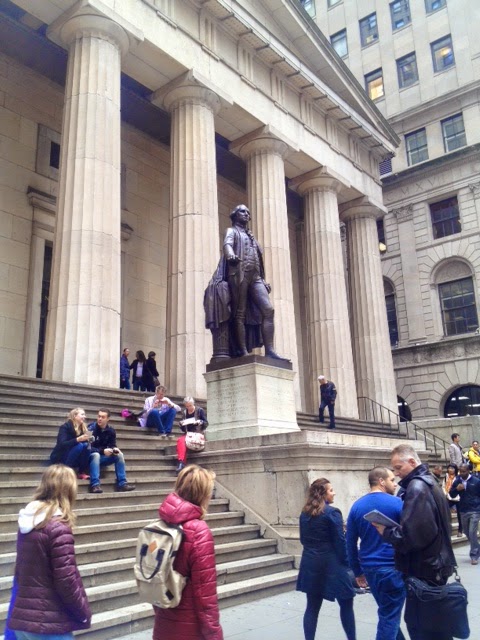
Federal Hall in New York City: The
site of Washington's first inauguration
Washington, the president, was very conscious of the precedents that he would be setting. He is often portrayed as a reluctant president, and in some ways he probably was. It was a shocking display of republican values that Washington could resign his generalship after the war. He feared that accepting the presidency would confirm to the world that he was just as power hungry as successful generals before him, not the Cincinnatus Americans saw him as. At the beginning of his generalship, presidency of the Constitutional Convention, and presidency of the United States, Washington made it clear that he had been compelled to do the job. Whether he wanted nothing more than to live out his days at Mount Vernon, he was a masterful politician, or something in between, there is no doubt that he was extremely sensitive about how history would view him. The thought that the country he had given much of his life to help form might require his stewardship to incubate its new government likely left him feeling that he had no choice but to serve. For a man who was unanimously elected president three times (Constitutional Convention and twice as President of the United States), the partisanship between Jeffersonians and the Hamiltonians (i.e. the republicans and the federalists) that took form during his second term was difficult on Washington and quickly wore him down both mentally and physically.
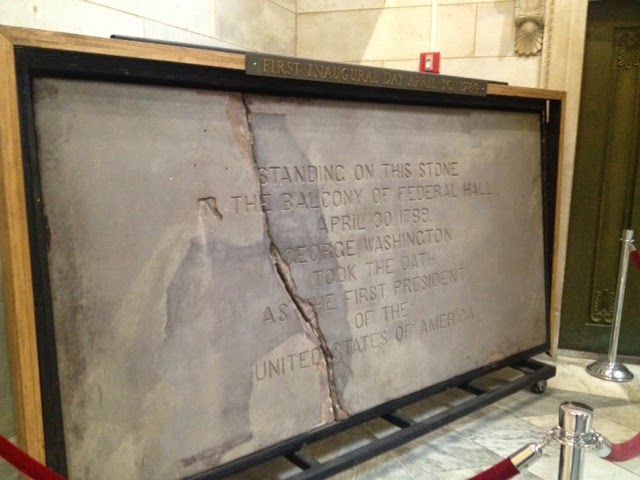
Inside Federal Hall are many Washington relics including
this stone slab on which Washington stood during his first
inauguration.

The issue of slavery is the most troubling aspect of Washington’s character. Washington clearly knew he was on the wrong side of history as a slave owner. He spoke of manumission with abolitionist peers such as Lafayette. Hamilton, maybe not worthy of the title abolitionist, also pushed Washington against slavery. However, Washington never made the stand against slavery that he could have. His signing of the Fugitive Slave Act, efforts to capture slaves that escaped from Mount Vernon, and ability to tailor his views on slavery to fit his audience paints a picture of a man who recognized the contradiction of slavery in the new republic but did not believe the young nation or his personal finances could afford to challenge the institution. In a final act of courage on the issue, or perhaps cowardice, Washington’s will called for the emancipation of his slaves upon Martha’s death. She ultimately freed them soon after Washington died.

October 12, 2014

ASIDE: Washington in New Jersey: The War

My odyssey through the presidents begins with Ron Chernow’s Washington: A Life.

Having grown up in Northern New Jersey, George Washington was somewhat of a presence. Legend has it that George had picnicked under a local oak tree, visited his soon to be trusted general Lord Stirling at Stirling’s local estate, and spent two winters in Morristown with his army (albeit less famously than their Valley Forge winter).
Mrs. Theodosia Ford’s Mansion in Morristown, Washington’s HQ during the winter of 1779/80


It turns out that Washington’s troops spent a great deal of the Revolution moving throughout New Jersey. It was from General Charles Lee’s ill-fated eponymous fort on the banks of the Hudson that Washington narrowly escaped death, a feat he repeated many times, and watched General William Howe’s Red Coats kill or capture nearly 3,000 American soldiers across the river at Fort Washington.

Washington’s Christmas crossing of the Delaware is likely his most famous act in New Jersey, but its significance in the war was unknown to me. Washington was coming off of a disastrous loss of New York City to the British highlighted by the loss at Fort Washington, troops were deserting in droves, and New Jersey residents were declaring their loyalty to the British much as those of New York City had done. It seemed unlikely that Washington’s army or the revolution itself was going to survive the winter of 1776/77 if Washington couldn't change the tide. Such was the context of Washington’s decision to gamble the future of the revolution on a Christmas-night raid of Johann Rall’s Hessian troops at Trenton. The importance of success at Trenton was underscored by Washington’s decision to keep the raid a secret from his troops, even as they marched toward the river. As an aside, it is shocking to read about the deplorable state of the American army, Chernow describes Washington’s men’s “bare feet tracing bloody streaks in the snow” as they marched toward the river. The crossing was a day-long affair. The march toward the river began mid-day on Christmas and the 2,400 men hadn't finished crossing until 3:00am. At that point, it was a nine mile march, through a nor’easter, to Trenton. The fighting began at 8:00am and contrary to legend, the Hessians were not hung-over from Christmas revelry, however they were likely caught off guard given the storm. The final tally counted nearly 1,000 Hessians killed or captured and less than 10 American deaths, mostly from succumbing to the weather. From Trenton, Washington’s army went on to defeat Cornwallis’s troops at Princeton giving him two improbable victories going into the winter encampment at Morristown and changing the tone of the Glorious Cause.

A depiction of the crossing by artist Peter Fiore
With half of Chernow’s book left to go, I look forward to learning more about Washington’s years after the war, especially as the first American president.